
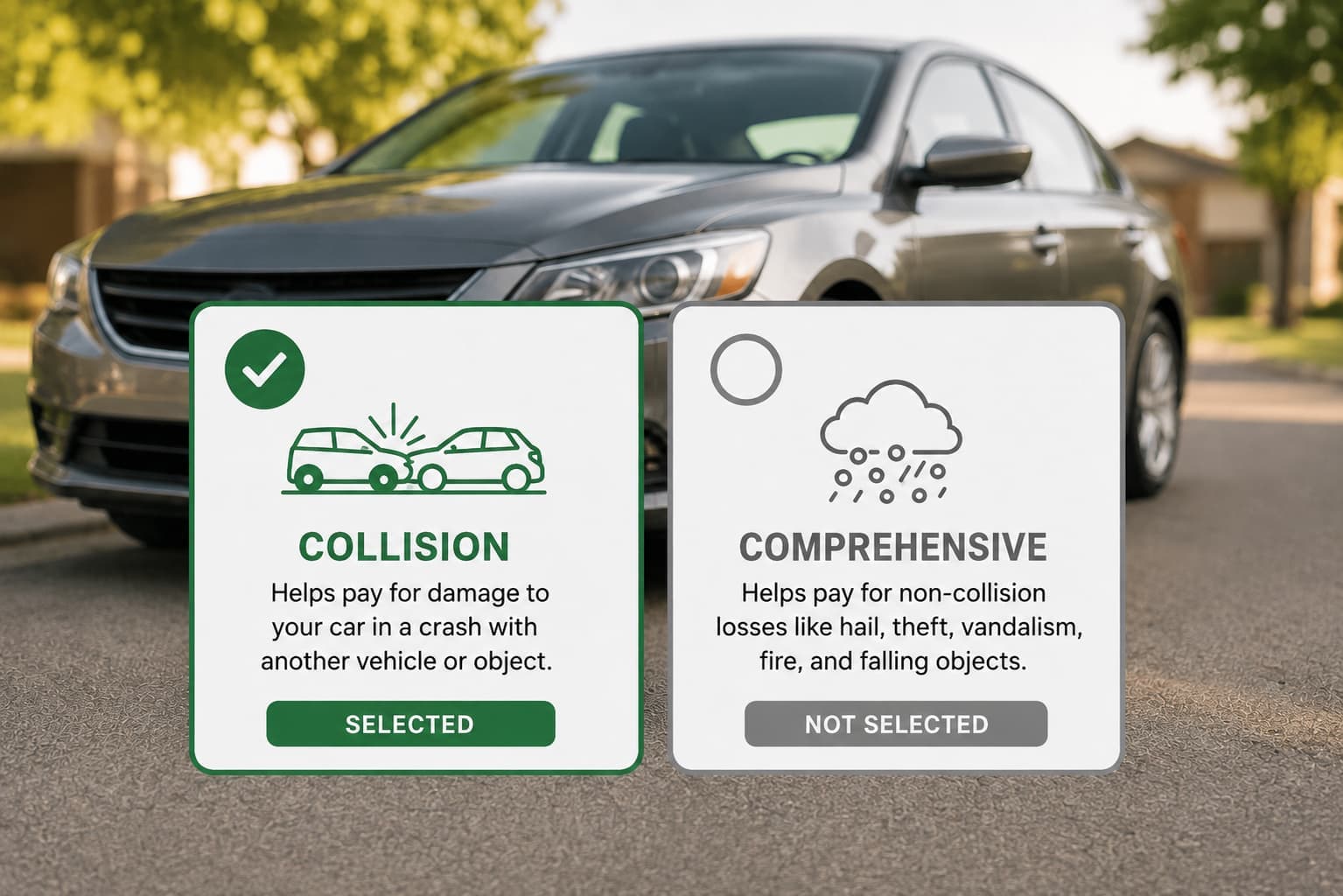
Yes. You can have collision without comprehensive insurance in Oklahoma if your insurance company allows that coverage combination and you do not have a lender requiring both.
The two coverages protect against different types of damage. Collision covers eligible crash damage, while comprehensive covers non-collision losses such as hail, theft, vandalism, fire, and falling objects.
Without comprehensive, damage from hail, theft, vandalism, and other non-collision events would no longer be covered under that part of the policy.
Collision and Comprehensive Cover Different Types of Damage
What drivers commonly call full coverage car insurance in Oklahoma usually combines liability insurance with collision and comprehensive coverage.
Collision protects your vehicle against covered damage from a crash, such as:
- Hitting another vehicle
- Hitting a guardrail, pole, or other object
- Rolling the vehicle
- Certain single-car accidents
Comprehensive protects against covered losses that are not collisions, including:
- Hail
- Theft
- Vandalism
- Fire
- Windstorm damage
- Falling objects
- Animal strikes
Neither collision nor comprehensive is required by Oklahoma law. Oklahoma treats collision and comprehensive as optional physical-damage coverages, although financing requirements can change what you are allowed to remove.
Can You Keep Collision and Drop Comprehensive?
Yes, if your insurance company allows that combination and you do not have a lender requiring both.
This is where company rules matter.
Some insurers allow collision and comprehensive to be selected independently. Others require comprehensive to be on the policy before collision can be added.
So even though Oklahoma law does not require you to carry the two together, the insurance company may have its own underwriting rules.
If you want collision without comprehensive, the easiest way to know whether it is available is to have that coverage combination quoted.
What Would Collision Without Comprehensive Cover?
If you kept collision and removed comprehensive, your vehicle could still have protection for covered crash damage.
For example, collision could apply if you:
- Rear-end another vehicle
- Back into a pole
- Hit a guardrail
- Lose control and roll the car
But you would no longer have comprehensive protection for covered losses such as hail, theft, vandalism, fire, or a falling tree branch.
That distinction matters in Oklahoma because a vehicle does not have to be moving for a major loss to happen.
A car parked in a driveway can still be damaged by hail or a severe storm. Without comprehensive coverage, collision would not take its place.
Can You Have Comprehensive Without Collision?
Yes, depending on the insurance company.
Comprehensive without collision is another coverage combination some insurers offer.
A driver with a paid-off vehicle might decide that protection against hail, theft, fire, or vandalism is still useful while choosing not to insure the vehicle against collision damage.
Again, the available setup depends on the insurance company.
The important point is that collision and comprehensive cover different risks, so removing one does not expand the other.
Can Collision and Comprehensive Have Different Deductibles?
Yes, when the insurer offers different deductible selections.
For example, a vehicle could have:
Collision deductible: $1,000
Comprehensive deductible: $500
The amounts do not automatically have to match.
Insurance companies vary in which deductible amounts and combinations they offer. Collision and comprehensive should be reviewed separately rather than assuming one deductible applies to both.
What If Your Car Is Financed?
If the vehicle is financed or leased, you may not be allowed to remove comprehensive coverage.
The lender has a financial interest in the vehicle and can require both collision and comprehensive until the loan is paid off.
A lender can also set limits on the deductible you choose.
Before changing either coverage on a financed vehicle, check the loan agreement and confirm:
- Collision is still required
- Comprehensive is still required
- The deductible is within the lender’s allowed amount
Those requirements can vary between lenders. The coverage rules for a vehicle with a lienholder are separate from Oklahoma’s minimum legal insurance requirements.
What If You Own the Car Outright?
You have more flexibility once there is no lender requiring physical-damage coverage.
At that point, the decision can come down to what types of losses you want the policy to protect against.
Before removing comprehensive, consider what would happen if the vehicle were:
- Stolen
- Damaged by hail
- Vandalized
- Damaged by fire
- Hit by a falling object
- Struck by an animal
Before removing collision, consider whether you could repair or replace the vehicle yourself after a covered crash.
Vehicle value matters too. As a car gets older, the cost of collision and comprehensive coverage can be weighed against what the vehicle is worth and what you could reasonably handle without that coverage.
Should You Carry Collision Without Comprehensive?
If your car is financed or leased, your lender may require both collision and comprehensive coverage.
If you own the vehicle outright, you have more flexibility. The decision comes down to which risks you want to keep insured and which ones you are comfortable taking on yourself.
Before removing comprehensive, compare:
- What comprehensive coverage costs
- Your comprehensive deductible
- The current value of the vehicle
- What it could cost to repair hail, storm, or vandalism damage
- Whether you could replace the vehicle yourself if it were stolen or destroyed by a covered non-collision loss
This is especially worth considering in Oklahoma, where hail and severe storms can damage a vehicle even when it is sitting in a driveway or parking lot.
Keeping collision without comprehensive means you still have protection for covered crash damage, but you would be responsible for losses such as theft, hail, vandalism, fire, falling objects, and other comprehensive claims.
Whether that setup makes sense depends on the vehicle, the cost of the coverage, and the options your insurance company offers.