
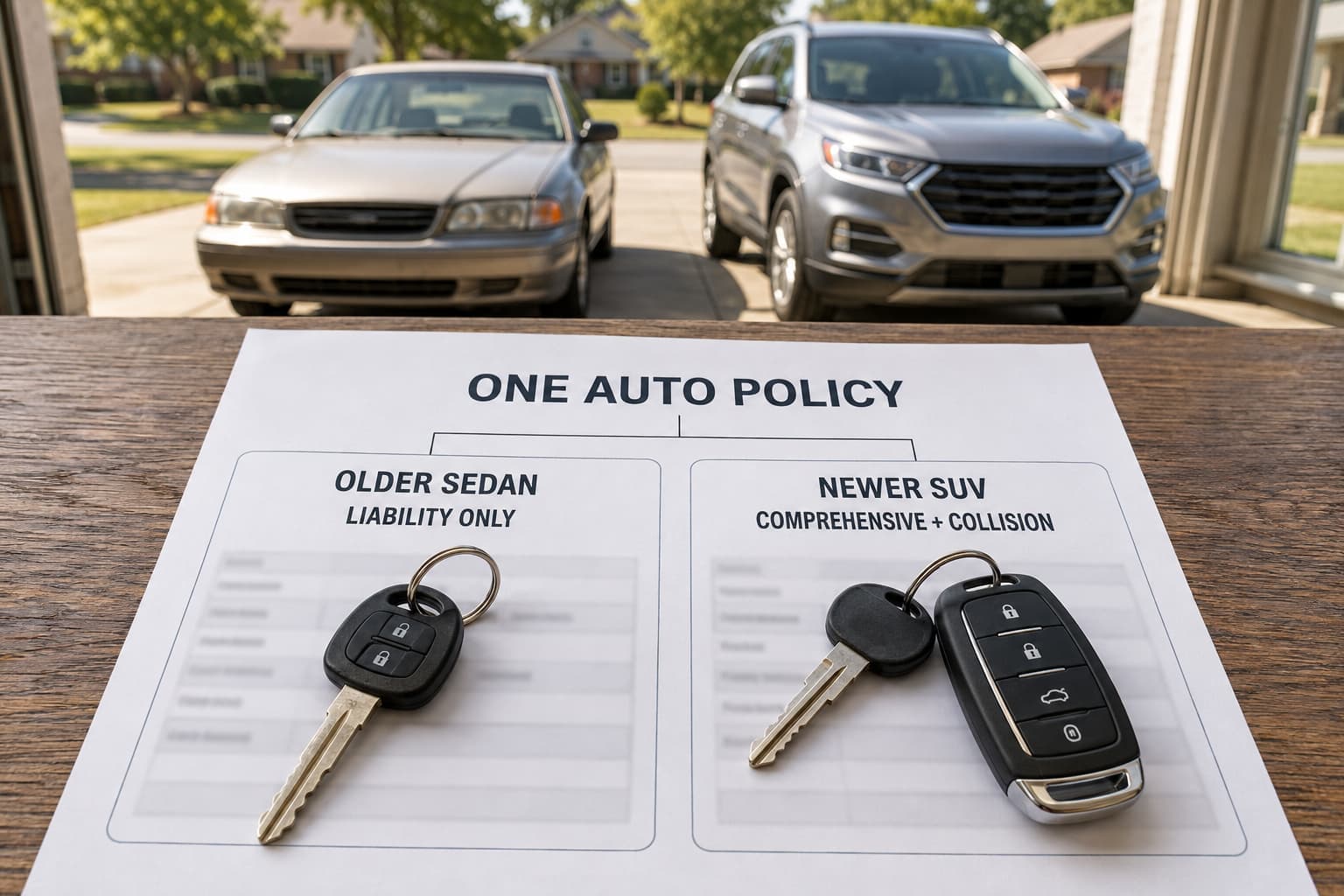
Yes. Two cars can often stay on the same insurance policy without carrying all the same coverage.
A Tulsa household might have a newer SUV with comprehensive and collision coverage and an older paid-off sedan with liability-only coverage. Both vehicles appear on one policy, but the coverage protecting each car can be different.
The important part is knowing which coverage applies across the policy and which options are listed separately for each vehicle.
How Different Coverage on the Same Policy Works
A multi-car policy brings two or more vehicles together under one policy. That does not necessarily mean every car must have identical coverage.
Liability limits commonly apply across the policy. If the policy carries the minimum liability limits required in Oklahoma, for example, those are generally the liability limits shown for the covered vehicles.
Coverage for damage to the individual cars can often be selected separately. That includes:
- Comprehensive coverage
- Collision coverage
- Comprehensive deductibles
- Collision deductibles
- Rental reimbursement
- Roadside assistance
The options available depend on the insurance company, but this structure allows households to insure each vehicle differently while keeping them together on one policy.
What Could Different Coverage Look Like?
Consider a Tulsa household with two vehicles:
- A paid-off 2012 sedan
- A financed 2025 SUV
The household may choose liability-only coverage for the sedan while keeping comprehensive and collision on the SUV.
Here is how that could appear:
| Coverage | Paid-off sedan | Financed SUV |
| Liability | Included | Included |
| Comprehensive | Not selected | Included |
| Collision | Not selected | Included |
| Comprehensive deductible | Not applicable | Listed on the policy |
| Collision deductible | Not applicable | Listed on the policy |
| Rental reimbursement | Not selected | Included |
| Roadside assistance | Not selected | Included |
This is only an example. The available combination will depend on the company’s rules, the vehicles, and any financing or leasing requirements.
What Does Liability-Only on One Car Mean?
Choosing liability-only coverage for one vehicle does not remove that car from the policy. The vehicle remains insured under the liability coverage shown on the policy.
Liability coverage generally helps pay for covered injuries or property damage the insured driver causes to someone else. It does not normally pay to repair or replace the insured vehicle following an at-fault accident.
Without comprehensive and collision, damage to that vehicle may not be covered following events such as:
- An at-fault collision
- Theft
- Hail
- Fire
- Vandalism
- A falling object
- Other physical damage ordinarily handled by comprehensive or collision
That limitation applies to the vehicle without those coverages. It does not mean comprehensive and collision have been removed from the other car.
Does Full Coverage on One Car Extend to the Other?
No coverage should be assumed to transfer from one listed vehicle to another.
If the SUV has comprehensive and collision but the sedan does not, the sedan generally does not gain those coverages simply because both cars appear on the same policy.
“Full coverage” is also an informal term rather than the name of one standardized insurance product. It commonly refers to a policy that combines liability with comprehensive and collision, but the declarations page shows what was actually selected for each vehicle.
Understanding what full coverage includes can help clarify the difference between coverage protecting other people and coverage protecting the insured vehicle.
Can the Cars Have Different Deductibles?
They often can.
A household might select a $500 collision deductible for one vehicle and a $1,000 collision deductible for another, subject to the insurance company’s available options.
Comprehensive and collision can also have different deductibles on the same car. For example, a vehicle might carry a $500 comprehensive deductible and a $1,000 collision deductible.
The deductible only belongs to the vehicle and coverage beside which it is listed. A deductible shown for the SUV’s collision coverage should not be assumed to apply to the sedan.
What If One Car Is Financed?
A financed or leased vehicle can still share a policy with a paid-off vehicle. However, the lender or leasing company may require comprehensive and collision on the car connected to its contract.
That requirement does not necessarily mean the paid-off vehicle must carry the same coverage. The household may still have flexibility with the paid-off car, depending on the insurance company’s rules.
Before changing coverage on a financed or leased vehicle:
- Review the financing or leasing agreement
- Confirm the required comprehensive and collision coverage
- Ask whether there is a maximum deductible
- Make sure the correct lienholder is listed
Oklahoma’s liability requirement and a lender’s coverage requirement are separate. A policy can satisfy the state requirement while still failing to satisfy the terms of a vehicle loan.
Check the Declarations Page Vehicle by Vehicle
The declarations page is the easiest place to confirm whether two vehicles have different coverage.
Find each vehicle and review the coverage listed with it. Check:
- Year, make, model, and VIN
- Comprehensive coverage
- Collision coverage
- Comprehensive deductible
- Collision deductible
- Rental reimbursement
- Roadside assistance
- Lienholder information
- Effective date of the coverage
Do not stop after reviewing the first vehicle. Each car should have its own coverage details clearly displayed.
After requesting a policy change, review the updated declarations page. Make sure the intended coverage was changed on the correct vehicle and that coverage on the other car remained in place.
Before Asking for Different Coverage
If you want to place different coverage on two cars, have the following information ready:
- The vehicle that should carry comprehensive and collision
- The vehicle that should carry liability-only coverage
- The preferred deductibles for each eligible car
- Any lender or leasing requirements
- The optional coverage wanted for each vehicle
Ask how the change will affect the policy price, then review the updated coverage before the change takes effect.
Two Cars Can Share a Policy Without Matching Completely
Two vehicles on the same Tulsa auto policy can often have different comprehensive, collision, deductible, and optional coverage selections.
One car may carry liability-only coverage while another carries what is commonly called full coverage. The vehicles can remain together on one policy, but each car’s protection should be confirmed separately.
Save Money Car Insurance can help Tulsa drivers review how coverage is listed for each vehicle and price the available options.
Frequently Asked Questions
Can one car have liability-only while another has full coverage?
Often, yes. Both cars can remain on the same policy while comprehensive and collision are selected for only one vehicle. The available arrangement depends on the insurance company and any lender or lease requirements.
Do both cars have to use the same deductibles?
Not always. Comprehensive and collision deductibles can often be selected separately for each vehicle, based on the options offered by the insurance company.
Does full coverage on one car cover the other car?
No coverage should be assumed to extend automatically. Comprehensive and collision generally apply to the vehicle for which they are listed. Check the declarations page for each car.
Can a financed car and paid-off car share one policy?
Yes. A financed and paid-off vehicle can generally appear on the same policy. The financed vehicle may need comprehensive and collision to satisfy its loan agreement, while the paid-off vehicle may have different options.
Will both cars have the same liability limits?
Liability limits commonly apply across the auto policy. Comprehensive, collision, deductibles, and certain optional coverages are more likely to be listed separately by vehicle. Confirm the exact arrangement on the declarations page.