
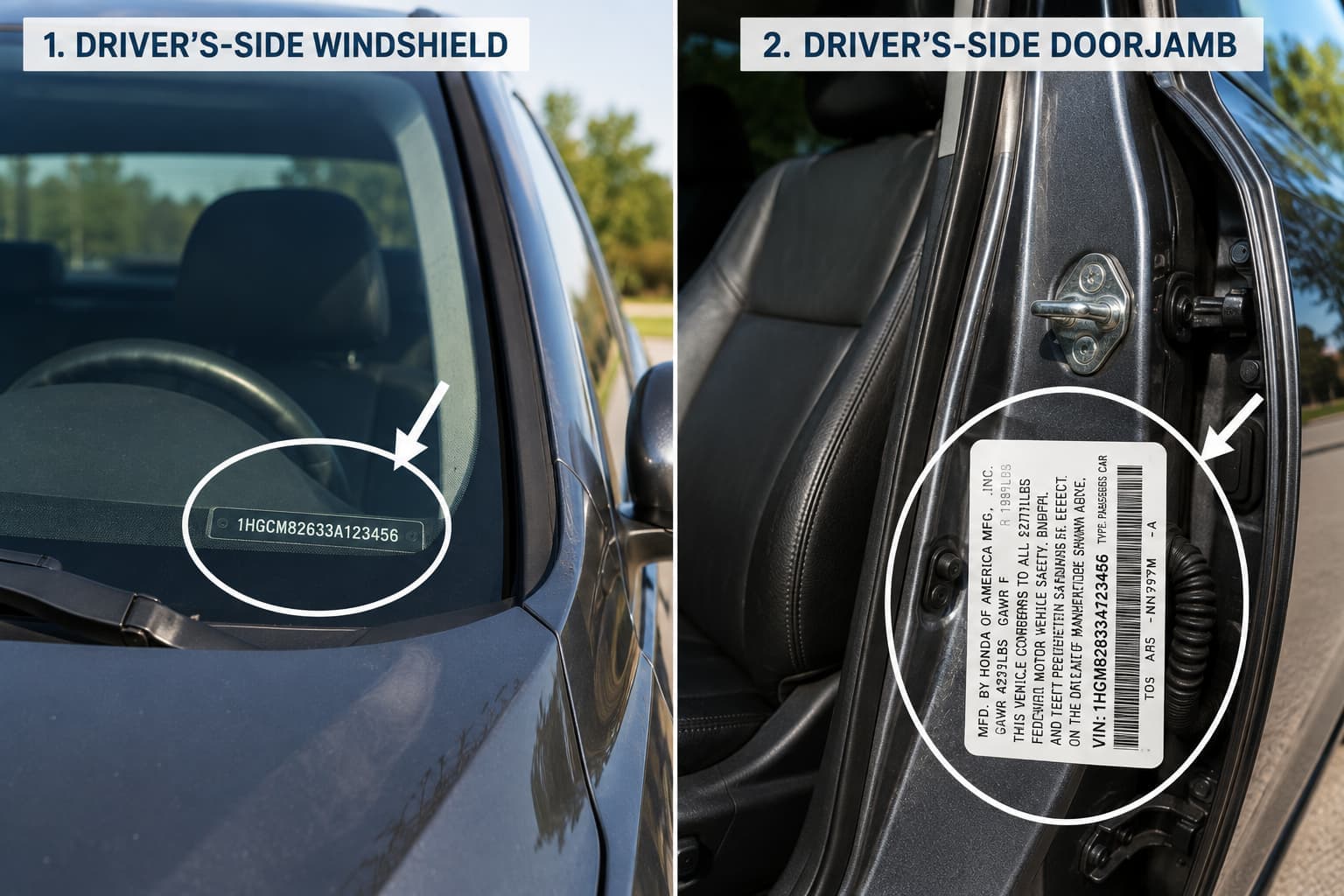
Si está buscando el número de identificación de su vehículo (VIN), no es el único. Ya sea que esté comprando un auto, contratando un seguro, registrando su vehículo o consultando información del vehículo, una de las primeras cosas que necesitará es el VIN.
La buena noticia es que por lo general es fácil de encontrar.
En la mayoría de los vehículos, el VIN se ubica en dos lugares principales:
- A través del parabrisas del lado del conductor, donde el tablero se une con el vidrio.
- En el marco de la puerta del lado del conductor, normalmente en una calcomanía o etiqueta del fabricante.
También puede encontrar el VIN en varios documentos del vehículo, incluidos su título, su registro, su tarjeta de seguro y el papeleo de compra.
En los vehículos fabricados después de 1981, el VIN es una combinación única de 17 caracteres entre letras y números que identifica su vehículo específico.
Veamos dónde encontrarlo y por qué es importante.
Los Lugares Más Comunes para Encontrar Su VIN
La mayoría de los conductores solo necesitan revisar uno o dos lugares antes de encontrar el VIN.
1. Parabrisas del Lado del Conductor
Este suele ser el lugar más fácil de revisar.
Párese fuera del vehículo y mire a través de la esquina inferior del parabrisas del lado del conductor. Verá una pequeña placa metálica sujeta al tablero con el VIN grabado.
Como se puede ver desde fuera del vehículo, esta suele ser la forma más rápida de localizar el número.
2. Puerta o Marco de la Puerta del Conductor
Si no ve el VIN a través del parabrisas, abra la puerta del conductor.
La mayoría de los vehículos tienen una etiqueta de certificación del fabricante en la puerta, el pilar de la puerta o el marco, que incluye el VIN junto con otra información, como las recomendaciones de presión de las llantas y la fecha de fabricación del vehículo.
3. Título del Vehículo
Si tiene su título a la mano, encontrará el VIN impreso en él.
Este suele ser uno de los lugares más fáciles para verificar el VIN cuando el vehículo no está cerca.
4. Registro del Vehículo
Su tarjeta de registro también incluye el VIN.
Muchos conductores la usan al actualizar su seguro o renovar su registro.
5. Tarjeta de Seguro o Documentos de la Póliza
Muchas compañías de seguros imprimen el VIN en las tarjetas de identificación del seguro y en las páginas de declaraciones.
Es una forma práctica de verificar que está viendo el vehículo correcto en su póliza.
6. Documentos de Compra o de Préstamo
Si compró o financió un vehículo recientemente, el VIN normalmente aparece en su contrato de compra, en el papeleo del financiamiento o en los documentos del préstamo.
¿Qué Pasa Si No Encuentra el VIN?
A veces encontrar el VIN no es tan sencillo.
Si tiene dificultades para localizarlo, aquí hay algunas cosas que puede revisar:
- Limpie la esquina inferior del parabrisas si la suciedad o el polvo dificultan la lectura de la placa.
- Vea el VIN desde fuera del vehículo en lugar de desde adentro para reducir el reflejo.
- Revise la etiqueta de la puerta del lado del conductor si la placa del parabrisas es difícil de ver.
- Compare el VIN en su registro o título si el vehículo no está disponible.
- Si la placa del VIN parece dañada o falta, consulte el manual del propietario o comuníquese con el fabricante del vehículo para pedir orientación.
La mayoría de los vehículos tienen más de un lugar donde se puede verificar el VIN, así que si una ubicación no está disponible, por lo general otra sí lo está.
¿Cómo Se Ve un VIN?
Saber qué está buscando hace mucho más fácil encontrar el VIN.
Un VIN moderno contiene 17 caracteres formados por letras y números.
Por ejemplo:
1HGCM82633A123456
Para ayudar a evitar confusiones, los VIN no usan las letras I, O ni Q, ya que se pueden confundir fácilmente con los números 1 y 0.
Cada carácter tiene un propósito y ayuda a identificar cosas como el fabricante, el tipo de vehículo, el año del modelo, la planta de ensamblaje y el número de serie único del vehículo.
¿Por Qué Su Compañía de Seguros Le Pide el VIN?
Una vez que encuentre el VIN, es probable que lo use para más de una cosa.
Las compañías de seguros usan el VIN para identificar el vehículo exacto que se está asegurando.
Aunque el año, la marca y el modelo dan información general, el VIN confirma el vehículo específico que se está agregando a su póliza.
Por ejemplo, el VIN ayuda a asegurar que sus documentos de seguro coincidan con:
- El vehículo correcto.
- Su título o registro.
- La información de su prestamista, si el vehículo está financiado.
Proporcionar el VIN correcto ayuda a reducir las probabilidades de retrasos o correcciones después de que se emita su póliza.
Antes de Darle el VIN a Su Compañía de Seguros
Antes de pedir una cotización o actualizar su póliza, tómese un minuto para verificar el VIN.
Una comparación sencilla ahora puede ahorrarle tiempo después.
Verifique que el VIN en:
- El vehículo
- Su título o registro
- Sus documentos de seguro
coincida en todos.
Si va a leer el VIN por teléfono, tome primero una foto clara para poder consultarla con cuidado.
Un solo carácter incorrecto puede identificar un vehículo completamente distinto, así que vale la pena revisarlo dos veces antes de enviar la información.
Una Revisión Rápida del VIN Puede Ahorrarle Tiempo Después
La mayoría de los conductores puede encontrar su VIN en menos de un minuto; simplemente no siempre saben dónde buscar.
Empiece por el parabrisas del lado del conductor y luego revise el marco de la puerta del lado del conductor si es necesario. Si el vehículo no está disponible, su título, su registro, su tarjeta de seguro o el papeleo de compra también pueden ayudarle a localizarlo.
Una vez que encuentre el VIN, tómese unos segundos más para verificarlo antes de usarlo para una cotización de seguro, un cambio de póliza o la compra de un vehículo. Es un paso sencillo que puede ayudarle a asegurarse de estar usando la información correcta del vehículo y evitar tener que corregir papeleo después.
Preguntas Frecuentes
¿Dónde está ubicado el número VIN en la mayoría de los autos?
La mayoría de los vehículos tienen el VIN en la esquina inferior del parabrisas del lado del conductor y en una etiqueta dentro del marco de la puerta del lado del conductor.
¿Puedo encontrar mi VIN sin el auto?
Sí. Su VIN normalmente está impreso en el título de su vehículo, su registro, su tarjeta de seguro, el papeleo de compra y muchos documentos de su póliza de seguro.
¿El VIN aparece en mi tarjeta de seguro?
Sí. La mayoría de las tarjetas de seguro incluyen el VIN del vehículo asegurado. También lo puede encontrar en su página de declaraciones. Si su vehículo está cerca, de todos modos es buena idea comparar el VIN de sus documentos de seguro con el VIN del vehículo para asegurarse de que coincidan.
¿Qué hago si no puedo leer el VIN a través del parabrisas?
Revise la etiqueta del fabricante dentro de la puerta del lado del conductor. Si aun así no logra localizarlo, compare el VIN de su título o registro, o comuníquese con el fabricante del vehículo para pedir ayuda.